Palladio's villas · Vicenza

Villa La Rotonda, Palladio's perfect villa

Villa Almerico Capra, known as La Rotonda, is the centrally planned villa Andrea Palladio designed on the hills just outside Vicenza: four identical façades, a dome and a constant dialogue with the landscape.

  • Guiding since 2008
  • Licensed guide no. 05000058
  • Private tours only
  • IT · EN · FR

At a glance

What is Villa La Rotonda in Vicenza?

Villa La Rotonda in Vicenza, also known as Palladio's Villa Capra, is the villa Andrea Palladio designed from 1566-67 for the cleric Paolo Almerico, later completed by Vincenzo Scamozzi. It stands on a small hill south-east of the centre, a short distance from Villa Valmarana ai Nani, and is part of the UNESCO site "La città di Vicenza e le ville del Palladio nel Veneto" (City of Vicenza and the Palladian Villas of the Veneto). It is the private property of the Valmarana family and opens on a limited basis, so a visit must always be checked in advance. With a licensed guide it can be included in a half-day Palladian villas tour.

The history of Villa Almerico Capra: from Paolo Almerico to the Valmarana family

Paolo Almerico was a Vicenza-born churchman who had spent many years in Rome in the service of the papal curia. On returning to his home city in 1565, he commissioned Andrea Palladio to design a residence on the hillside, conceived not as the centre of a working farm, like many other Venetian villas, but as a place of quiet, study and representation. Work began around 1566-67, and within a few years the building was habitable. Palladio published it in his Four Books of Architecture (1570), describing a site surrounded by hills that offer a view as if from a great theatre.

Neither Almerico, who died in 1589, nor Palladio, who died in 1580, saw the villa finished. In 1591 the property passed to the brothers Odorico and Marco Capra, who entrusted its completion to Vincenzo Scamozzi: to him we owe the dome, lower than in the original design and opened by an oculus recalling the Pantheon in Rome, and the farm buildings. The Capra family kept the villa until the early nineteenth century and had the interiors decorated. After several changes of ownership, in 1912 the villa was bought by Count Andrea Valmarana, whose descendants still look after its conservation.

Why is it called "La Rotonda"?

The nickname comes from the great circular hall beneath the dome, the heart of the building. The official name, Villa Almerico Capra, recalls the two families who commissioned it and saw it through to completion.

The architecture: a central plan, four porticoes and a dome

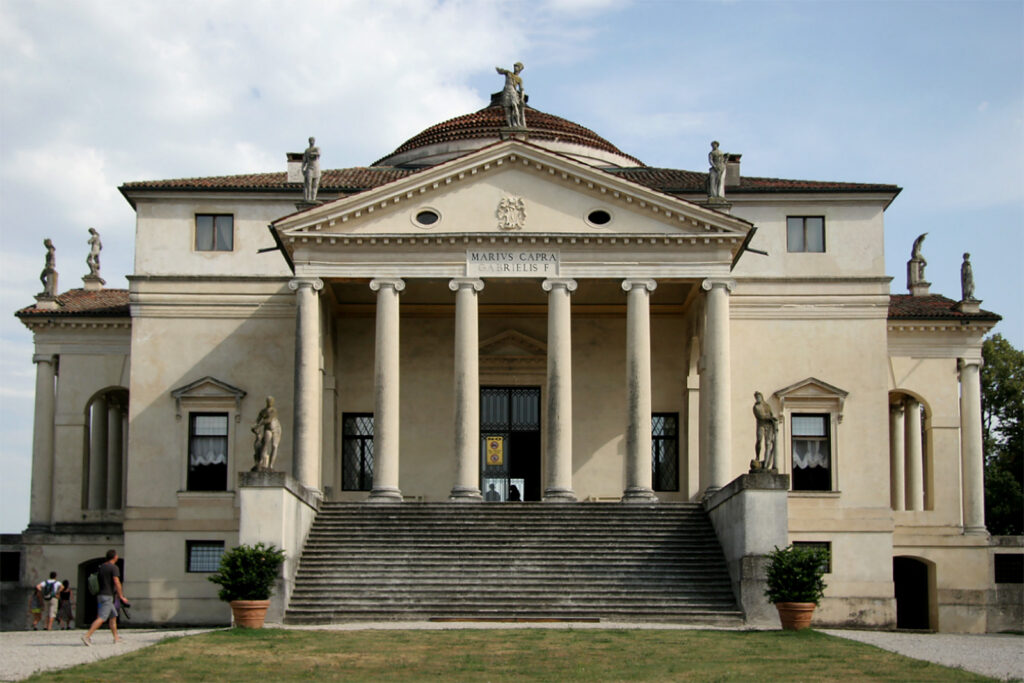
La Rotonda is built on a perfectly symmetrical square plan, arranged around a circular hall. On each of the four sides opens a pronaos, a portico of Ionic columns with a pediment, reached by a broad flight of steps: an element Palladio took from ancient temples and transferred, with great daring, to a private home.

The result is a building with no back. Each façade looks out onto a different landscape: the city, the river Bacchiglione, the Berici hills, the countryside. The porticoes are true observatories over the territory, and the villa itself becomes the centre of an ordered panorama. The statues of classical deities on the pediments complete the image of a secular temple facing nature.
  • Symmetry: four equivalent façades, with the corners of the building facing the cardinal points.
  • Proportion: harmonic ratios between the rooms, inspired by the Roman architecture Palladio studied.
  • Landscape: the hill becomes the building's natural plinth.
Façade of Villa La Rotonda in Vicenza with its Ionic-columned portico and flight of steps
One of La Rotonda's four porticoes, all identical and each facing a different landscape.

Interiors

Frescoes and stucco: a century in the making

Most of the interior decoration was carried out after the deaths of Palladio and Almerico, at the wish of the Capra family, and some attributions are still debated.

The central hall and the dome

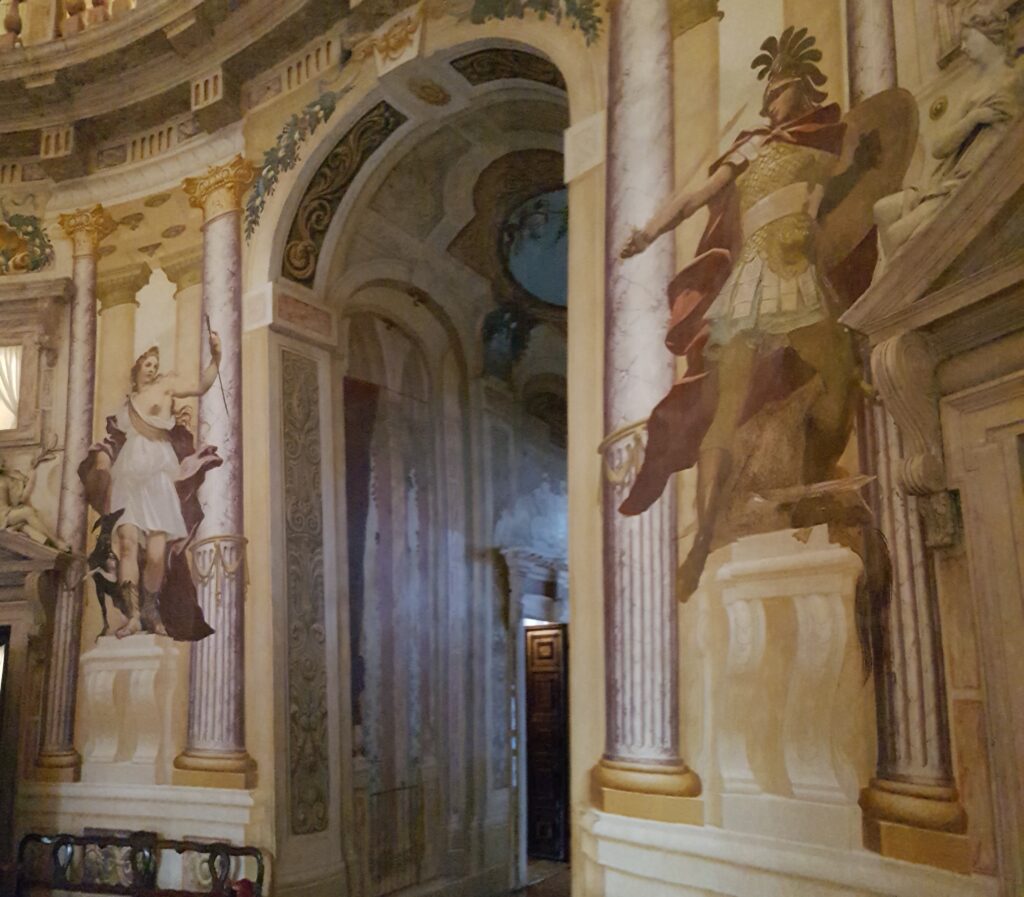
The dome was frescoed around 1600 by Alessandro Maganza with allegories of religion and the virtues, framed by late sixteenth-century stucco work associated with the circle of Alessandro Vittoria. The walls of the circular hall were painted later, in the early eighteenth century, by the French painter Louis Dorigny: trompe-l'œil architecture and great Olympian deities that, through an illusionistic effect, seem to step out of the walls.

The corner rooms

In the rooms and small chambers of the main floor there are ceilings frescoed by Alessandro Maganza and, in one of the rooms, work attributed to Anselmo Canera. The sources also mention Bernardino India, Giovanni Battista Maganza and the stuccoists Agostino Rubini, Ruggero Bascapè and Domenico Fontana; the statues are attributed to Lorenzo Rubini and Giovanni Battista Albanese.

The frescoed dome of the central hall at Villa La Rotonda, with its oculus and stucco work
The dome of the central hall, completed by Vincenzo Scamozzi.

A frescoed interior room at Villa La Rotonda in Vicenza

A frescoed room on the main floor.

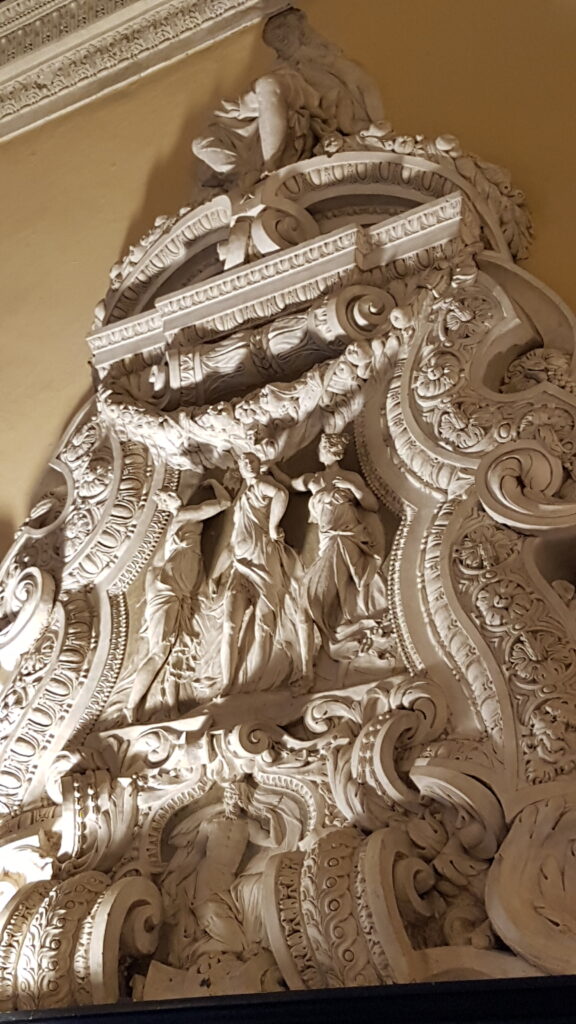
Decorative stucco work in the interiors of Villa La Rotonda

Stucco work, an essential part of the decoration.

La Rotonda's influence around the world

Thanks to the Four Books and their translations, La Rotonda became a model for architects across Europe and beyond. In England, eighteenth-century Palladianism drew some of its best-known works from it: Chiswick House in London, built for Lord Burlington, and Mereworth Castle in Kent, designed by Colen Campbell. In the United States, Thomas Jefferson looked to the Vicenza villa for Monticello and for a design, submitted anonymously, for the President's House.

Visiting La Rotonda therefore means seeing the origin of an architectural language you will recognise in country houses, public buildings and university campuses in many countries.

How to visit Villa La Rotonda

The villa stands on Via della Rotonda, on the lower slopes of the Berici hills, and can be reached from central Vicenza on foot with an uphill walk, or by car. It is private property: the garden and the interiors open to the public only on certain days and at certain times of year, and some parts can be seen only on special occasions. Check the calendar and booking arrangements on the villa's official website before planning your day.

With your guide

  • Reading the architecture and the landscape from the four porticoes
  • The story of the patrons and of the decoration
  • Advice on which admission tickets to book and when (you book them directly)
  • Can be combined with Villa Valmarana ai Nani

Good to know

  • Limited opening: availability is always checked when you send your request
  • Admission tickets are not included in the guide's fee
  • The hill has uphill stretches and steps
  • Rules on photographing the interiors are set by the owners

Gallery

Images from the tour

Frequently asked questions

Villa La Rotonda: visitors' questions

Are Villa La Rotonda and Villa Capra the same villa?

Yes. The official name is Villa Almerico Capra, after its two patrons: Paolo Almerico and the Capra brothers, who bought it in 1591. "La Rotonda" is the nickname that comes from the circular hall beneath the dome. You will also see the name Villa Almerico Capra Valmarana, after the family that owns it today.

Can you visit the interiors of La Rotonda?

The interiors open only on certain days and at certain times of year, because the villa is a private home. The calendar can change during the year, so it is best to check it on the official website. Daniela checks opening days when you send your request and tells you which tickets to book and when; you book them directly.

Who completed La Rotonda after Palladio?

After Palladio's death in 1580, the work was overseen by Vincenzo Scamozzi on behalf of the Capra family. He was responsible in particular for the dome, lower than in the original design and opened by an oculus inspired by the Pantheon.

Who frescoed the dome of La Rotonda?

The dome was frescoed around 1600 by Alessandro Maganza with allegories of religion and the virtues. The great deities on the walls of the central hall, on the other hand, are by Louis Dorigny, from the early eighteenth century.

How far is La Rotonda from Villa Valmarana ai Nani?

The two villas are very close and are linked by a footpath, the Valletta del Silenzio. This is why they are often visited in the same half-day, as on the tour dedicated to the villas of Vicenza.

Can you walk there from central Vicenza?

Yes, it is a walk of about half an hour, partly uphill, or a short trip by car or bus. Daniela can suggest the most suitable route depending on your time and your group's mobility.

Private tour

Discover La Rotonda with a licensed guide

Let us know your dates, the number of people and your language: Daniela checks the villa's opening days and suggests an itinerary, with clear terms before you confirm.

What guests say

Reviews on TripAdvisor

Excerpts from 5-star reviews published on TripAdvisor, quoted in the original Italian with an English translation. Full texts on the platform.

Palladio e Teatro Olimpico

«Lascia a bocca aperta.»

Translation: Leaves you speechless.

Giorgio P.June 2020 · TripAdvisor

La Fabbrica del Rinascimento con Daniela

«Non ho staccato gli occhi un attimo e il tempo è volato.»

Translation: I never took my eyes off it and the time flew by.

Anna PietribiasiDecember 2021 · TripAdvisor

Visita guidata alla mostra «La fabbrica del Rinascimento»

«Lei è molto competente, interessante e mai banale.»

Translation: She is very knowledgeable, interesting and never trite.

Rosanna R.January 2022 · TripAdvisor

La Fabbrica del Rinascimento

«Spiegazioni chiare e precise.»

Translation: Clear and precise explanations.

raffa206January 2022 · TripAdvisor

Fine settimana di autunno

«Guide preparate con tour molto interessanti e ben illustrati.»

Translation: Well-prepared guides with very interesting, well-explained tours.

Beatrice F.November 2021 · TripAdvisor

Figures taken from the platforms in October 2026. How we display reviews

Torna in alto